
Picabia’s Gertrude Stein and Len Lye’s Ladies Home Journal
In 2017, I convened a small symposium at the University of Auckland in support of an exhibition I had curated at the Len Lye Centre called On an Island. The exhibition concerned the friendship between Len Lye, Laura Riding and Robert Graves, particularly during Lye’s three-month stay with Graves and Riding at their Mallorcan retreat in 1930. The symposium was an opportunity to explore some wider issues around that friendship and Lye’s activities with Riding and Graves’s Seizin Press. It’s been a topic that has lingered with me and, over the last year, my attention has been set on Lye’s place in the relationship between Riding and Gertrude Stein – the writer that completed the Seizin Press stable at its launch in 1927.

This month, Art New Zealand will publish my article No Trouble to Wear Green – a consideration of Riding’s professional courtship of Stein and how Lye was useful to such ends. Central to this was Riding’s 1928 gifting to Stein of a couple of batik silk shawls made for Stein by Lye. In various drafts of the essay I addressed what these shawls looked like, assembling fragmentary details from various letters between Riding, Stein and Lye. In the end, my focus shifted to the nature of the relationships involved in the gift rather than the objects themselves.
I still wonder at the scarves – what they looked like and, if extant, where they may be. Numerous of Lye’s batiks (all dating to the late 1920s or early 1930s) have survived today. Beyond the ten examples in the Len Lye Foundation collection are two owned by the Robert Graves Estate (below) and one in the collection of the Victoria and Albert Museum. Until recently, the V&A batik resided in that collection unattributed to Lye. Perhaps a similar fate befell the Stein shawls?

You might hope works owned by such collectors as Stein and her lover, Alice B. Toklas, to be well documented even if not still resident in collections derived from their estate. Yet, I find no mention of Lye’s shawls in insurance records associated with the Stein and Toklas Collection. Nor do the curators of The Gertrude Stein and Alice B. Toklas Collection at Yale’s Beinecke Library have any knowledge of the shawls. I’ve searched fruitlessly through hundreds of photographs, across numerous archives, looking at Stein, Toklas, and their art collection hoping to see either of Lye’s gifts documented by chance. Remarkably, a well-known portrait of Stein painted by Francis Picabia in 1933 may be just that.

Although overshadowed by Stein’s enduring friendship and collaborative association with Picasso, Picabia was a friend of several decades and in particularly close and regular contact with Stein in the years following Lye’s gift. The portrait of Stein was painted around June 1933 following one of Picabia’s frequent visits to Stein and Toklas’s summer home in Bilignin. The portrait (above) depicts Stein in a bucolic setting, seated outdoors surrounded by a verdant landscape. She wears a confusing costume, described by Washington’s National Portrait Gallery as a tunic over her torso with a toga around her knees and and back. The portrait is remarkable for portraying Stein outside the salon environment and for the fleshy exposure of her bare shoulder. The costume is considered Picabia’s invention; however, the patterns on the fabric bear a resemblance to Lye’s sketches in a short letter accompanying the gifted batiks.
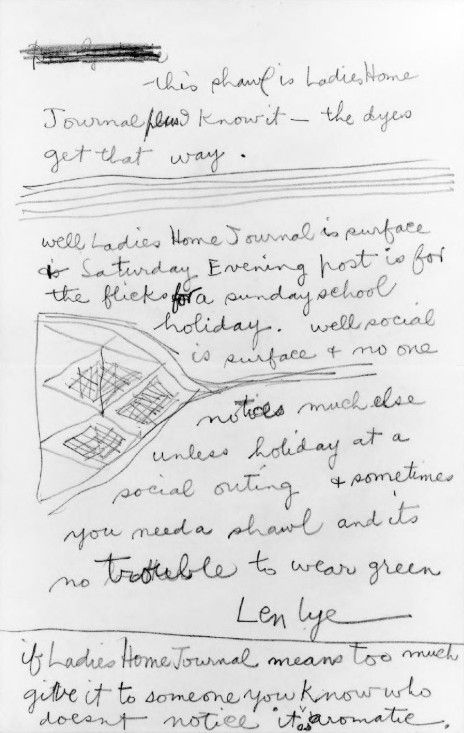
In his letter to Stein, Lye introduces one of the shawls as Ladies Home Journal, which I take to be its title in the absence of any alternative. The letter is dominated by a sketch of what Riding termed (in a separate letter to Stein) a “sieve shape”. The interior of the funnel-like figure is filled with several cross hatched elements suggesting a filtration material or system. From Riding’s description, what I understand of Ladies Home Journal reminds me of Lye’s Watershed batik (below), a near-contemporaneous work with imagery of filtration and purification.

Easy to overlook above Lye’s sieve figure in this letter is the band of five parallel lines drawn horizontally across the page. If these two elements reside in Ladies Home Journal, Lye gives no clear indication of how they constitute the composition, sitting as they do in his letter as discrete figures. However, both the sieve and the band of lines have some correspondence to the garment wrapped around Stein in Picabia’s portrait. The upper portion of what Stein is wearing involves five bands of black parallel lines on a white ground. In this case, generally in bands of four; however, one band involves five, as in Lye’s sketch. The bands are horizontal, but for a downward turn on Stein’s left side, suggesting the contour her breast and an embodied abstraction in Stein’s wearing of the shawl.
In the portrait, the lower portion of the shawl features a triangular shaped and cross hatched pattern similar to Lye’s sieve figure in the letter. This section is rendered green by Picabia, corresponding to letters between Stein and Riding where the shawl’s greenness is discussed with Stein commenting that “it’s ok to wear green or not green” and Lye echoing the point in his own letter with “it’s no trouble to wear green”.
We can take caution with the view that this is imagery of Lye’s batik. Lye should have been aware of his work featuring in a portrait by Picabia, an artist he admired even before his arrival in Europe in 1926. There is also close to no commentary from Lye on what he produced for Stein. Outside his letter, the only reference I’m aware of is a recollection in his autobiographical Happy Moments (c. 1960s) of Metropolitan Museum curator Jessie McNabb’s recent enquiry to Toklas on the whereabouts of Stein’s shawl. Toklas’s response is another reason to pause. She had no recollection of Lye’s gift at all – understandable given her age and health in the 1960s, but curious should the batik have been part of such a prominent portrait as Picabia’s.
Interesting to me is Stein’s comment to Riding that the batik is warm to wear. That “wearing” of the garment is to me the crucial point. Most of Lye’s batik shawls and scarves seem to have been little worn, in most cases displayed as if they were paintings. Riding’s own batiks were mounted on the wall for display during the 1930s. Likewise, examples retained by Lye and now in the Len Lye Foundation’s collection have no documented use as articles of clothing. Since Stein wore these shawls, could they have been important enough to be worn in Bilignin for Picabia’s portrait? Did she pose for Picabia wearing the shawl or could he have worked from a more general knowledge of it? I’m fascinated by the idea that Picabia may have registered both Lye’s work and an element of Stein’s everyday material world in what is considered an imaginative vision.
You can order Art New Zealand Issue 199 with No Trouble to Wear Green here.
Coda: The Trouble with Wearing Green
If Ladies Home Journal really was predominantly green, another surviving Lye batik may offer a clue to why the shawl itself has disappeared. Energy Radiations, made at about the same time, was documented by Lye in good condition during the 1970s. By the early 2000s it had deteriorated dramatically. The degradation was isolated to the green-dyed areas where the silk had perished while neighbouring colours remained comparatively stable. A more substantially green composition, frequently worn by Stein, may have had a short lifespan.


Comments