
Capture Photography Festival
One of the pleasures of Vancouver’s Capture Photography Festival is the absence of a heavy-handed curatorial theme. Festivals often strain to unify disparate practices under a single idea, but Capture instead allows the exhibitions to speak on their own terms. The result is a festival that feels representative of photography’s current moment: expansive, experimental, and unconstrained by boundaries. Rather than leaning into a central curatorial proposition, the strongest exhibitions reveal a medium comfortable inhabiting its own provocations.
A standout exhibition of this year’s festival was Steven Dragonn’s Vancouver may never be poetics between Montparnasse and Mongkok at Canton-sardine. Few galleries are better suited to an exhibition exploring the romanticization and reality of place than Canton-sardine, whose labyrinthine architecture is a challenging ambulation. Dragonn’s (frequently large-scale) photographs explore the notion of belonging, a theatre stretched between Guangzhou, Paris, and Vancouver, treating each city less as a location than an uneasy condition of being.
Steven Dragonn, Vancouver may never be poetics between Montparnasse and Mongkok, Canton-sardine
Questions of migration and inheritance continue in Karen Zalamea’s Every Surface is a Shrine at the Art Gallery at Evergreen. Zalamea considers the movement of images, histories, and memories across generations. Drawing on family photographs and the intertwined histories of colonialism, migration, and knowledge production, the exhibition asks what survives these journeys and in what form. Its most compelling works are not images but objects: ropes fabricated from enlarged and reprinted family photographs. Here photographs cease to function primarily as representations and become physical structures.
Karen Zalamea, Every Surface is a Shrine, Art Gallery at Evergreen
This concern about photography’s objecthood reappeared throughout the festival. The group exhibition Experiments in Photography: Image and Object at North Van Arts offered the clearest survey of artists working beyond conventional photographic forms. Unsurprisingly, the results were an uneven embrace of experimentation over coherence. Among the highlights were Val Loewen’s screen-printed photographs on scrunched leather and Stephanie Gagné’s retro advertising photographs cropped and paired with wooded silhouettes of objects in the image, the artist’s playful reification the most impressive approach to the exhibition’s invitingly open proposition.
Val Loewen, Experiments in Photography: Image and Object, North Van Arts
Maya Fuhr’s Sole Parts at Equinox Gallery offered a series of images in which women’s shoes are encased in fleshy latex and the material subsequently peeled away. The resulting skins, fragile and indexical, preserve the memory of the original object. The process recalls Heidi Bucher’s practice around latex architectural skins with the attendant risk of dermatophobic reactions. Yet Fuhr’s background in fashion and commercial photography makes the work feel intimate and inviting, rewarding a second glance.
Maya Fuhr, Sole Parts, Equinox Gallery
Patryk Stasieczek’s for the gob casts an image at Wil Aballe Art Projects shifts attention away from the photograph and towards the concept of the camera, turning the photographer’s own body into the image-making apparatus. Using his mouth as a camera obscura, a “single oral lens,” he produces abstract images while foregrounding the messy process of their production. Saliva interferes with chemistry, pulse rates determine exposure times, and the body becomes both apparatus and obstacle. The exhibition’s deliberately unruly installation mirrors the experiment itself. Rather than pursuing technical mastery, Stasieczek embraces contingency and failure.
Patryk Stasieczek, for the gob casts an image, Wil Aballe Art Projects
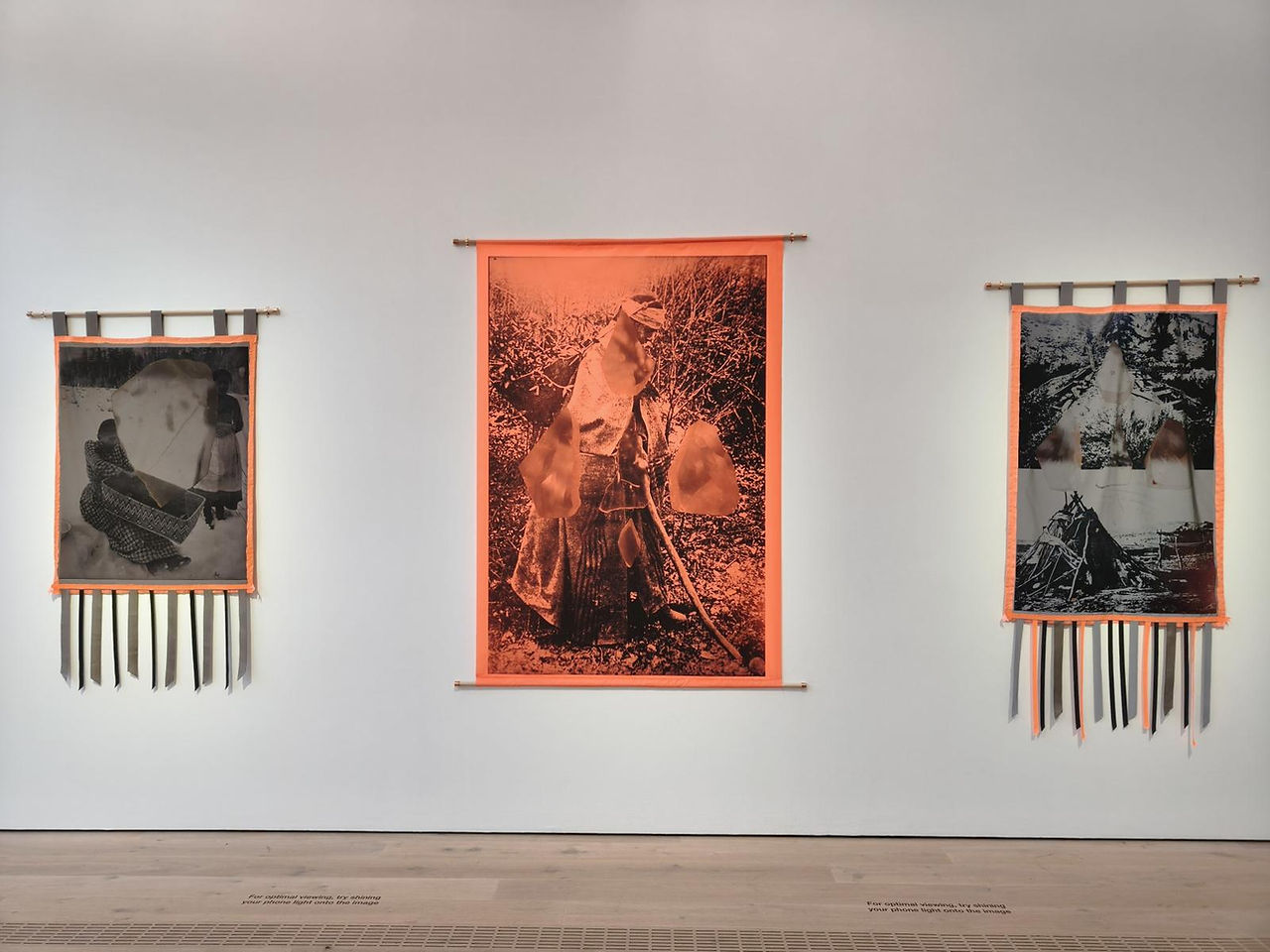
Whereas the preceding artists challenge assumptions about what photographs can become, Tanya Willard’s Photolithics at The Polygon Gallery challenges assumptions about what photography has always been. The exhibition advances a provocative proposition: photography does not begin with the invention of the camera but with the interaction of light, stone, minerals, land, and time. In doing so, Willard removes photography from a narrowly technological history and situates it within much longer geological and Indigenous histories. Photography no longer appears as a modern invention subsequently employed for colonial purposes but as a phenomenon that precedes human ownership altogether. It is a bold reframing and the highlight of the festival (appropriate for a photo-centric institution like The Polygon).

Tanya Willard, Photolithics, The Polygon Gallery

A firm but unflashy reminder of photography’s place within Vancouver’s cultural identity happened at the Vancouver Art Gallery. Stephen Shore’s Uncommon Places, drawn from the gallery’s recent and substantial acquisition of the artist’s prints, sat comfortably alongside Highlights from the Collection, a survey that reinforced a larger truth: Vancouver is one of the world’s great photographic cities and a principal investor in the photographic medium having a central place in contemporary art practice.
Jeff Wall (left), Highlights from the Collection, Vancouver Art Gallery
Sitting just outside the official Capture programme, the Vancouver Art Gallery and Emily Carr University’s co-hosted conversation with Nan Goldin provided a suitable coda. Goldin, arguably one of the most influential photographers of the last fifty years, spent much of the evening in conversation with Eva Respini, discussing editing, narrative, and filmmaking rather than photography itself. “I always wanted to be a filmmaker,” she remarked, describing her celebrated slideshows as “film[s], made out of stills.” She playfully confessed, “I don’t really like photography very much. I’m starting to like it now, but it’s taken me 50 years.” It was less a rejection of the medium than a reminder of its elasticity.

Yet the same flexibility poses a challenge. If photography can be so fluid, what becomes of photography itself? The question feels particularly pressing at a moment when many arts institutions, including Emily Carr University, are suspending photography as a distinct programme of study. Capture offered a compelling counterpoint. Across the festival, photography appeared as objects, archives, performance, experiment, and even geological processes. Its boundaries proved remarkably porous, but its presence remained unmistakable. If anything, this year’s festival demonstrated that photography’s continued vitality lies not in moving on from the medium, but in continually expanding what it can be.


Comments